
Online vs In-Person Life Coaching: Choose the Format That Fits the Work
Compare online and in-person coaching through privacy, focus, access, technology, travel, communication, and a practical format experiment.
fact
ICF ethics standards apply confidentiality and technology responsibilities to coaching records, communications, platforms, software, and artificial intelligence.
fact
HHS telehealth privacy guidance recommends private spaces, secure communications, informed consent, and avoiding recordings unless necessary and agreed.
trivia
Online convenience can improve attendance while reducing privacy if a client joins from a shared room, vehicle in motion, workplace, or unsecured network.
fact
The coaching competencies remain the same across formats: the medium changes the operating conditions, not the need for agreements, listening, trust, and client growth.
Step 1
Start with the job the conversation must do
Online versus in-person is not a contest between modern and traditional coaching. It is an operating choice. A confidential leadership problem, a career transition, a habit project, and a walking coaching session may need different conditions. Write what the conversation requires: privacy, visual materials, movement, emotional candor, frequent access, a stable ritual, accessibility, or freedom from travel. The format should support those conditions without becoming the main event.
Separate preference from evidence. You may enjoy physical presence yet lose two hours to travel, or value online flexibility while discovering that a shared home prevents honest conversation. Neither observation makes one medium universally better. Describe the actual place, device, commute, schedule, and people nearby. The more concrete the setting becomes, the easier it is to predict friction and design a useful experiment.
Put this into practice
- ◆Name the work the session must support.
- ◆Describe the actual environment for each format.
- ◆Separate personal preference from recurring friction.
- ◆Include accessibility and energy, not only convenience.
Step 2
Treat online coaching as a real room with technical walls

A remote session needs a charged device, stable connection, working microphone, usable camera position if video is expected, and a backup channel. Test the link before the first paid session. Silence notifications, close unrelated windows, and place the device where you can think without monitoring your own image. Ask whether telephone fallback is available and whether a technical failure changes the session charge. These details prevent a valuable conversation from becoming troubleshooting.
Online coaching can widen geographic choice and reduce travel, which may improve consistency. It can also compress transitions: you may leave a stressful meeting and enter coaching seconds later, then return to work without reflection. Create a short arrival ritual and ten-minute buffer afterward. Convenience is valuable when it protects attendance, but it should not erase the preparation and integration that help a session produce action.
Put this into practice
- ◆Test the link, microphone, camera, and backup channel.
- ◆Silence notifications and remove unrelated screens.
- ◆Create a short arrival and exit buffer.
- ◆Confirm how technical failures affect the appointment.
Step 3
Evaluate the entire in-person journey, not only the room

Physical presence may make nonverbal communication, shared materials, movement, and separation from home easier. Evaluate the office before assuming those benefits. Ask about location, parking or transit, accessibility, waiting areas, sound privacy, restroom access, fragrance or sensory conditions, and who else uses the space. A beautiful room that is difficult to reach or easy to overhear can reduce consistency and candor.
Count travel and transition time as part of the service. The commute may provide useful reflection or create enough friction to cause missed sessions. Consider weather, caregiving, mobility, and workday constraints across the full engagement, not only the first enthusiastic week. Ask what happens when travel becomes impossible and whether a session can move online. A flexible hybrid policy can preserve continuity without pretending both experiences are identical.
One-question poll
Which condition is most likely to affect your coaching format?
Your choice is not stored and only changes the guidance displayed here.
Step 4
Build privacy on both sides of the connection

Ask the coach which platform is used, whether sessions are recorded or transcribed, which artificial-intelligence tools process content, how notes are stored, and what can be disabled. ICF ethics standards address technology systems and records, while HHS telehealth guidance—although written for clinical care—offers useful privacy questions about secure communications, private rooms, consent, and recording. Do not assume a familiar video brand answers every data-handling question.
Your environment matters too. Headphones do not prevent your voice from being overheard. Avoid driving, public Wi-Fi, open offices, and places where you must censor the central issue. If the only private option is a parked car, consider temperature, visibility, safety, and connection. For in-person work, ask about sound transfer, interruptions, reception staff, and records. Privacy is an operating arrangement, not a promise attached to one format.
Draw a simple information path before choosing a platform: what enters through voice, video, chat, shared documents, scheduling, payment, notes, transcripts, and recordings; where each item is stored; who can access it; and when it is deleted. Then decide which channels the goal actually needs. A session may work by telephone without video, or with a worksheet shared beforehand instead of screen access. Reducing unnecessary data is different from assuming perfect security. If either party changes tools during the engagement, revisit consent and the information path rather than treating the original agreement as permission for every replacement service.
Step 5
Notice how the medium changes attention and challenge
Some clients think more freely when sharing a physical room; others speak more directly from familiar surroundings. Video can intensify eye contact, hide body movement, create self-consciousness, or make visual tools easier to share. Telephone coaching removes visual cues and may improve concentration for some people. In-person work provides more environmental information but can also make status differences or social pressure feel stronger. These are hypotheses to test, not personality rules.
Ask the coach how the process changes across formats. Do they use a digital whiteboard, send materials in advance, invite movement, or adjust pauses when video creates delay? A strong coach can explain the adaptation without claiming the medium guarantees depth. Notice whether interruptions are repaired, silence remains comfortable, and challenge stays clear. Communication fit involves the coach, client, topic, and channel together.
Put this into practice
- ◆Identify which cues help you think and speak honestly.
- ◆Ask how exercises change across formats.
- ◆Notice self-view, delay, silence, and interruption effects.
- ◆Do not interpret medium preference as a character trait.
Step 6
Make accessibility and inclusion explicit before the first session
Ask for the accommodations you need rather than hoping the format solves them automatically. Relevant needs may involve captions, screen-reader compatible materials, keyboard access, breaks, lighting, seating, sensory load, mobility, interpreters, language, camera flexibility, or the option to receive questions in writing. Confirm which platform features exist and test them. A nominally remote service can still be inaccessible, and a compliant building may not create a usable coaching environment.
Discuss cultural and household context without forcing disclosure. Camera use, eye contact, home visibility, caregiving interruptions, and travel freedom carry different meanings and constraints. The coach should work with practical conditions rather than treating every deviation as lack of commitment. Put important accommodations and format agreements in writing so they survive scheduling changes, substitute platforms, or a move between online and in-person sessions.
Step 7
Run a two-session format experiment when uncertainty is material
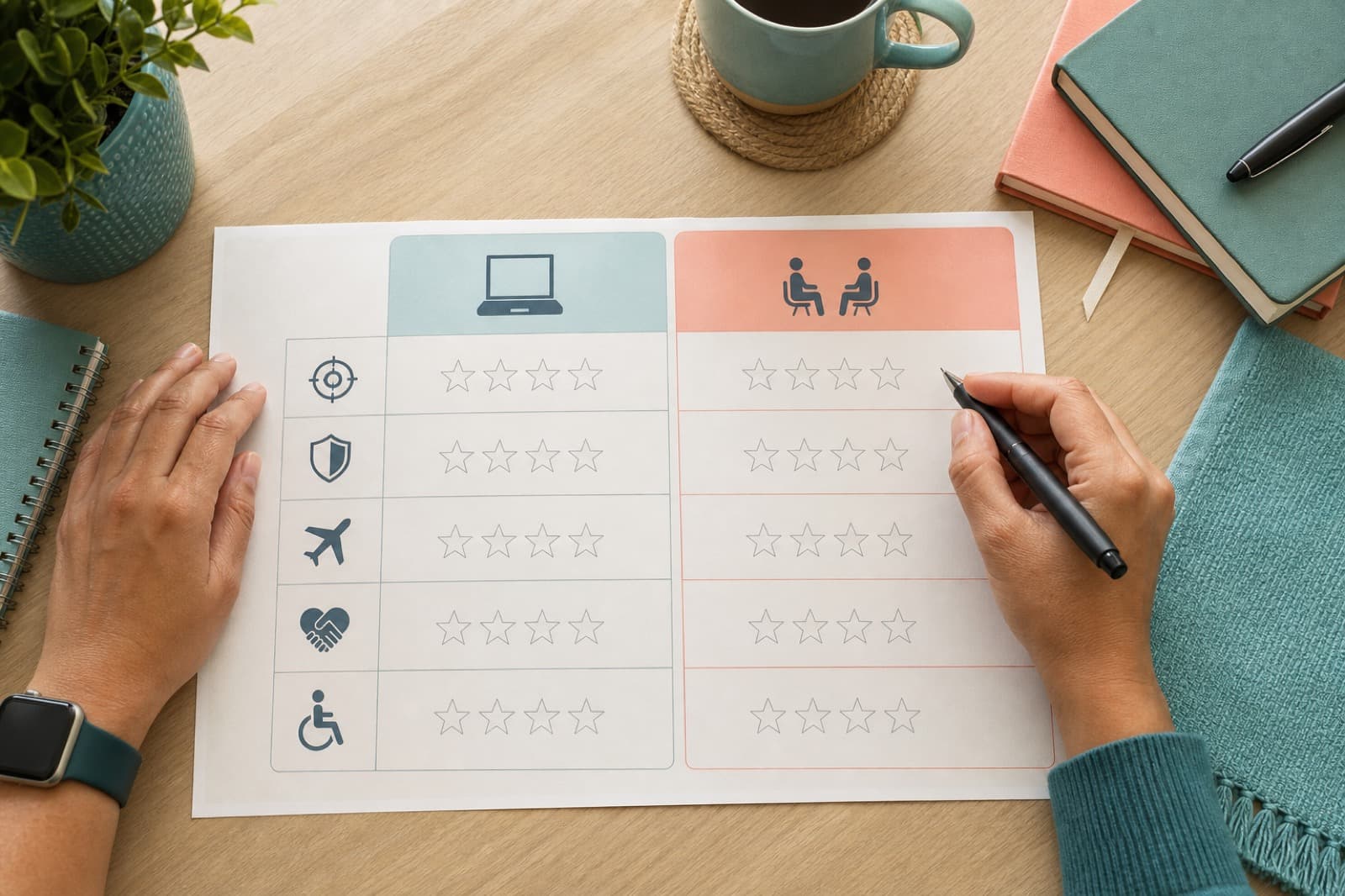
If both formats are available, compare one realistic session in each rather than touring an office and testing video under ideal conditions. Use a comparable level of difficulty. After each session, rate focus, candor, connection, accessibility, fatigue, travel or setup burden, privacy, technical friction, and quality of the action you carried forward. Write notes before deciding which experience should have been better.
A hybrid arrangement may win: in-person for an opening session or major review, online for continuity, and phone for a specific circumstance. Define how format changes are requested, what notice is required, and whether fees differ. Revisit the choice when work, home, health, location, or the goal changes. Format is infrastructure. Good infrastructure becomes nearly invisible because it reliably supports the work.
Keep the comparison fair. Use the same coach when possible, discuss similarly demanding material, schedule both sessions at representative times, and avoid judging one format after a technology rehearsal while testing the other during a crisis. Complete the rating immediately, then add a second note the next day about recall, follow-through, and recovery. The delayed note matters because a session can feel connected in the moment yet produce little usable action, or feel demanding while leading to a clearer decision. Choose from the combined evidence, not from novelty, room design, or one unusually smooth conversation.
Interactive tool
Coaching format readiness check
Evaluate the format you will actually use, not an idealized setup.
0 of 6 verified
Too many fundamentals are still unverified. Ask another round of questions before paying.
A format-readiness result and the operating conditions to test before committing.
Step 8
Choose the format you can use honestly, consistently, and safely
Make separate judgments about privacy, reliability, accessibility, communication, energy, and cost. Do not let one appealing feature erase a blocking condition. An online coach with rare expertise is not useful if your connection fails or you cannot speak privately. A local coach with excellent presence is not accessible if the journey repeatedly breaks your schedule. Resolve the conditions that can be changed and compare the remaining tradeoffs.
Record a backup plan. If online fails, decide whether to switch to phone, reschedule, or end early. If travel fails, know whether remote conversion is possible. If privacy disappears, postpone rather than disclose sensitive material in an unsafe setting. The best format is not a permanent identity. It is the current arrangement that lets the coaching relationship operate with clarity, candor, continuity, and appropriate protection.
Set a format review point alongside the coaching-goal review. Track late starts, cancellations, connection failures, travel time, privacy compromises, accommodation problems, and occasions when you withheld something because of the setting. A repeated operational problem is evidence, even if individual sessions feel productive. Ask whether a small repair—different headphones, a reserved room, an earlier appointment, camera flexibility, or a hybrid cadence—solves it. Include the practical cost of every repair in the comparison. If not, change the format or provider without turning the original preference into a promise. Continuity comes from an arrangement that adapts before friction quietly becomes disengagement.
Choose the next useful action
Sources and editorial notes
This guide provides consumer decision support, not medical, mental-health, legal, or financial advice. Credential requirements and consumer guidance can change; follow the linked publishers for current rules.
- ICF Code of EthicsInternational Coaching Federation · accessed 2026-08-01
- ICF Core CompetenciesInternational Coaching Federation · accessed 2026-08-01
- Develop a Privacy and Security Telehealth StrategyU.S. Department of Health and Human Services · accessed 2026-08-01
Editorial review: Life Coach Locator editorial team, 2026-08-01. Read our editorial methodology. Images are original generated assets and are labeled in their captions.